Class of 2028 FCS Offers Show an Accelerated Recruiting Timeline in New England Region
Class of 2028 FCS Offers Show an Accelerated Recruiting Timeline in New England Region
Tweet
SNE Data: 75 New England Prospects Already Hold Division I Offers in the Class of 2028 Recruiting Cycle
The Class of 2028 recruiting process is moving at a pace rarely seen before in New England.
According to Scouting New England’s current regional recruiting database, As of July 15, 2026 ,75 prospects connected to the Class of 2028 recruiting cycle have already been identified with at least one Division I verbal offer.
Many of these players have yet to begin their junior seasons.
That number provides clear evidence that the traditional recruiting calendar has accelerated. College programs are no longer waiting until the conclusion of a prospect’s junior season to begin making scholarship decisions. In many cases, staffs are evaluating sophomore film, verifying prospects during the spring and summer, and extending offers before the player enters his third varsity season.
The activity is not limited to a small group of nationally known recruits. SNE’s data shows Division I offers being earned by quarterbacks, offensive linemen, defensive linemen, linebackers, defensive backs, wide receivers, running backs, tight ends and multi-position athletes from across the region.
The Class of 2028 recruiting process in New England is already well underway.
The Numbers Show How Early Recruiting Has Become:
The most important part of this trend is not simply that 75 prospects hold offers. It is the range of recruiting activity represented within the group.
Some players have received one early opportunity. Others already hold five, 10, 20 or more verbal offers.
At the top of the database, several prospects have already developed into national recruits.
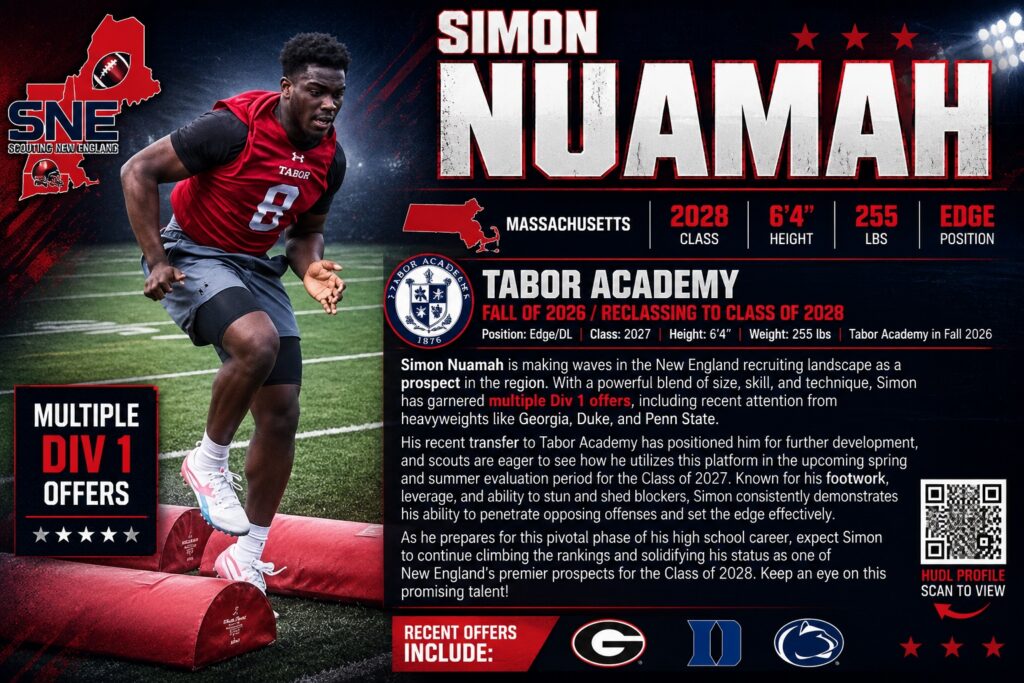
Simon Nuamah, a 6-foot-4, 255-pound Edge prospect transferring to Tabor Academy, is listed with offers from programs including Georgia, Penn State, Michigan, Notre Dame, Miami, Virginia Tech, Duke, Ole Miss and others.
Jeremiah Figaro, a 6-foot-4 athlete transferring from Malden Catholic to Dexter Southfield, has built another extensive national offer list that includes Tennessee, Notre Dame, North Carolina, UCLA, Virginia Tech, Wisconsin, Nebraska and several additional programs.
St. John’s Prep quarterback Christopher Vargas has also received offers from programs across the country, including Ohio State, Alabama, Oregon, LSU, Michigan, Penn State, Georgia, Texas A&M and Auburn.
Those three prospects represent the nationally recruited portion of the class, but the larger story is the depth behind them. New England’s offer activity is extending well beyond a handful of players at the top of the board.
Division I Programs Are Recruiting Every Level of the Region:
The offers documented by Scouting New England come from across the Division I landscape.
Power conference programs, Group of Five schools, Ivy League institutions and FCS programs are all evaluating the region earlier.
The offer list includes schools such as:
Boston College, Syracuse, UConn, UMass, Penn State, Michigan, Notre Dame, Maryland, Rutgers, Virginia Tech, Vanderbilt, Duke, Wake Forest, North Carolina, UCLA, Georgia Tech, Louisville and Tennessee.
It also includes regional and national FCS programs such as Rhode Island, Maine, Bryant, Holy Cross, Yale, Harvard, Brown, Dartmouth, Princeton, Columbia, Cornell, Penn, Georgetown, Colgate, Lehigh, Central Connecticut State and Sacred Heart.
That range matters.
Not every Division I prospect follows the same recruiting path. Some are being evaluated as national Power Four recruits. Others fit the academic and athletic profiles of the Ivy League or Patriot League. Many are emerging as strong regional FCS targets.
The growing number of offers across all levels shows that college staffs are not only identifying the elite prospects earlier. They are building deeper regional recruiting boards earlier as well.
Massachusetts and Connecticut Are Producing Significant Depth:
Massachusetts and Connecticut account for the largest portion of the prospects currently represented in SNE’s offer database.
Massachusetts has produced nationally recruited players such as Nuamah, Figaro and Vargas, along with a deep group of additional offer holders.
That group includes Liam Conlon, Xander Odenyo, Riley Selvais, Rory Funke, Ramar Thomas, Owen DeSalvo, Benjamin Walker, Landen O’Neil, Tommy Mahoney, Xzavier Chafin, Zachary McKenzie, Osiris Niven, David Sanger and several others.
The range of positions is notable. Massachusetts prospects have earned offers at quarterback, wide receiver, offensive line, defensive line, linebacker, defensive back and athlete.
Connecticut is also showing considerable depth.
The state’s offer holders include Christian King, Colten Lis, Ryan Sims, Breydon “Buddha” Evans, Joel Budd, Oliver Sims, Stephen Soares Jr., Foster Friess, Zachary Mancuso, Alex McCormack, Trae Ford, Walker McClure and several other developing prospects.
Connecticut’s offensive line group has attracted particularly strong attention. Multiple linemen measuring between approximately 6-foot-4 and 6-foot-8 have already received Division I opportunities.
The concentration of size and developmental upside at Connecticut prep programs has made the state an important evaluation area for college staffs.
New Hampshire and Rhode Island Are Also Producing Offer Talent:
Although Massachusetts and Connecticut have the largest totals, the recruiting activity is not limited to those two states.
New Hampshire prospects have also earned meaningful Division I opportunities.
Winnacunnet offensive lineman Josh Moore is listed with offers from Boston College, Syracuse and UMass.
Phillips Exeter offensive lineman Malik Drouin has received offers from UConn and Boston College.
St. Paul’s quarterback and linebacker Orion Yates has earned opportunities from Yale, UConn, Dartmouth, Penn and Cornell.
Phillips Exeter running back Fogo Filani has also received Division I attention, including offers from Dartmouth and UConn.
Rhode Island is represented by prospects such as Daniel Nichols, a multi-position athlete listed with a Brown offer.
These numbers may be smaller than the Massachusetts and Connecticut totals, but they reinforce an important point: Division I staffs are evaluating the entire New England region, not only its largest football markets.
Offensive Linemen Are Receiving Early Attention:
One of the clearest positional trends in the data is the number of offensive linemen receiving offers before their junior seasons.
College programs are always searching for size, length, movement ability and developmental potential along the offensive front. New England’s combination of public-school and prep-school football has produced several players who meet those early evaluation standards.
Offer-bearing linemen in the database include:
- Josh Moore, Winnacunnet.
- Tommy Mahoney, Dexter Southfield.
- Joel Budd, Somers.
- Oliver Sims, Brunswick.
- Malik Drouin, Phillips Exeter.
- Anthony Boniface, Suffield Academy.
- Foster Friess, Taft.
- Zachary Mancuso, Choate Rosemary Hall.
- Kaipeng Wang, Williston Northampton.
- Wentworth “Dubbs” Bloom, St. Thomas More.
- Alessandro Bennati, St. Thomas More.
- Cal Tompkins, Brunswick.
- Joe Roche, Darien.
- Emmanuel Prince Jjuuko, Brunswick.
Many of these prospects are already listed at 6-foot-4 or taller and between approximately 260 and 330 pounds.
Those measurements do not guarantee future success, but they provide college staffs with the physical starting point required to project a player into a Division I offensive line room.
For linemen, early recruiting is often based on projection. Coaches are evaluating what a sophomore may become after two additional high school seasons and several years in a college strength program.
New England has produced a significant number of prospects who fit that profile.
Prep-School Movement Is Influencing the Recruiting Landscape:
Transfers and reclassifications are another major part of the Class of 2028 recruiting cycle.
Several highly recruited prospects are entering new prep-school environments for the 2026 season.
Nuamah is transferring to Tabor Academy.
Figaro is moving to Dexter Southfield.
Liam Conlon is transferring from Catholic Memorial to Tabor.
Kaipeng Wang is moving from East Longmeadow to Williston Northampton and reclassifying.
Blake Nelson is transferring from Archbishop Williams to Milton Academy.
Emmanuel Prince Jjuuko is transferring from Fairfield College Prep to Brunswick and reclassifying.
These moves can provide prospects with an additional year of development, increased exposure, stronger weekly competition and access to a larger number of college evaluators.
The prep-school route has long been part of the New England recruiting structure, but its influence continues to grow. College staffs are tracking prospects before, during and after their transfers, and an offer may now arrive before the player has appeared in a game for his new program.
That adds another layer to the accelerated timeline.
A prospect may receive offers based on sophomore film from one school, transfer during the offseason, attend college camps in the summer and begin his junior season with an established Division I recruitment already in place.
Sophomore Film Is Becoming a Major Evaluation Tool:
Junior film remains extremely important, but college staffs are increasingly willing to make early decisions using sophomore varsity film.
When evaluating a younger prospect, coaches are not expecting a finished college player. They are looking for traits that can be developed.
Those traits include:
- Verified size and frame potential.
- Speed and explosiveness.
- Length and movement ability.
- Position-specific athleticism.
- Physicality.
- Competitive effort.
- Production against quality opponents.
- Versatility.
- Long-term developmental upside.
If those qualities are visible on sophomore film, a college staff can begin the recruiting process immediately.
The offer may be based partly on what the player has already accomplished and partly on what the staff believes he can become.
That is why updated film is so important for underclassmen. A prospect does not need to have every technical detail mastered, but the film must clearly show the traits that translate to the college level.
Camps Are Becoming Offer-Producing Events:
Film may begin the evaluation, but camps often provide the final verification.
College camps allow coaches to evaluate prospects directly and answer questions that film cannot always resolve.
Staffs can verify height, weight, length, speed, movement, flexibility and position-specific technique. They can also evaluate how a player responds to coaching, handles competition and performs against other college-level prospects.
For players already on a recruiting board, camp is not simply an opportunity to gain exposure. It can be a direct audition for an offer.
The timing of many offers in SNE’s database supports that conclusion. A significant amount of the activity occurred during the spring and summer evaluation period, when college coaches were hosting camps, visiting schools and conducting live evaluations.
That means, going forward prospects must prepare for camps as competitive evaluation opportunities rather than viewing them only as instructional events.
Early Offers Can Lead to Rapid Recruiting Growth:
One offer can change a prospect’s recruiting trajectory.
When a respected program offers a player, other staffs frequently return to the film or accelerate their own evaluations. A prospect who begins the spring with one offer can enter the summer with several.
That pattern is visible throughout the SNE data.
Some prospects received their first regional opportunity and then added Ivy League, FCS, Group of Five or Power Four interest in the following weeks. Others experienced major offer growth after attending camps or appearing at showcase events.
The first offer provides validation, but it also increases the urgency for competing programs.
No staff wants to discover too late that a prospect it had been monitoring has become a priority recruit for several other schools.
That competitive pressure is one of the primary reasons offers are being extended earlier.
The Transfer Portal Has Made High School Evaluation More Selective:
The transfer portal has changed college roster construction, but it has not eliminated high school recruiting.
Instead, it has made high school evaluations more selective.
College staffs can use the portal to add older players with college experience, but they still need high school prospects who can be developed over multiple seasons.
The challenge is identifying which younger players deserve those developmental roster spots.
Programs must decide earlier which high school prospects possess the physical tools, academic profile, positional value and long-term upside required to justify an offer.
That may lead to smaller high school recruiting classes at some programs, but it can also create greater urgency around the prospects a staff truly wants.
Once a player is identified as a priority, the college may offer early to begin building the relationship before the market becomes crowded.
What the Data Means for Unoffered Prospects:
The presence of 75 offer-bearing prospects does not mean the Class of 2028 evaluation process is complete.
Many future Division I players remain unoffered.
Some prospects have limited varsity film. Some are moving into starting roles for the first time. Others have experienced recent physical growth, changed positions or transferred to programs where they will receive more exposure.
The upcoming junior season will create another major wave of recruiting movement.
College staffs will be watching for prospects who:
- Make significant physical gains.
- Earn larger varsity roles.
- Show improved technical ability.
- Produce against stronger competition.
- Demonstrate positional versatility.
- Confirm their size and athletic ability at camps.
- Provide updated academic information.
- Show consistent development from sophomore to junior year.
The current offer total should motivate unoffered prospects, not discourage them.
Recruiting boards remain fluid, and junior film can still create major opportunities. However, the data makes one thing clear: prospects cannot wait until the end of junior year to begin preparing.
What Class of 2028 Prospects Should Be Doing Now:
Players with college football goals should already have the basic pieces of their recruiting profiles organized.
That includes:
- Updated sophomore highlight film.
- Full-game film when requested.
- Accurate height and weight.
- Verified academic information.
- Current contact information.
- A realistic position projection.
- A targeted college camp schedule.
- Communication with appropriate programs.
- A plan for producing updated junior film.
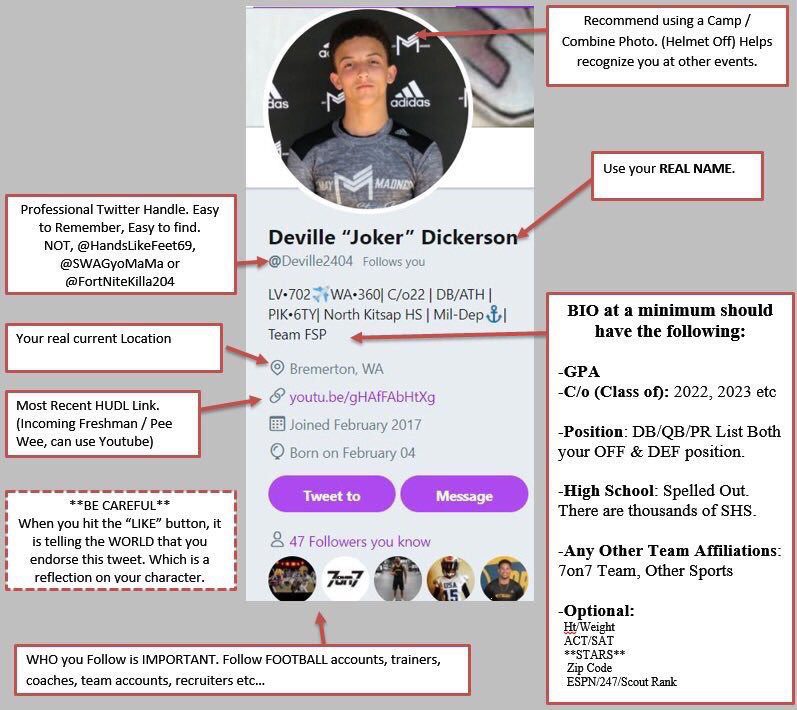
- An active Twitter (X) profile for increased visibility, along with promotional support from services like SNE, if needed.
Although we are nearing the end of college camp season, players should always be strategic about attending any remaining college camps.
Attending a large number of camps does not guarantee recruiting success. Prospects should prioritize schools that fit their academic and athletic profiles, programs that have communicated genuine interest, and events where position coaches will have an opportunity to evaluate them directly.
The goal is not simply to appear at a camp. The goal is to be evaluated by the right programs.
An Early Offer Is the Beginning, Not the Finish Line:
A verbal offer is an important accomplishment, but it does not complete the recruiting process.
Offers are based on a college staff’s evaluation at a specific moment. Prospects must continue to develop academically, physically and athletically.
They must also continue communicating with college coaches.
Families should ask clear questions about the offer, the prospect’s position on the recruiting board and the next steps in the process. Not every verbal offer carries the same level of urgency, and recruiting situations can change as college staffs fill positional needs.
The strongest approach is to appreciate the opportunity while continuing to improve.
Junior-season performance, academic progress, character and communication will all remain important.
The Scouting New England Staff Takeaway:
Scouting New England’s current data leaves little doubt that the Class of 2028 recruiting timeline has accelerated.
With 75 prospects in SNE’s regional tracking database already associated with Division I verbal offers, college programs are clearly evaluating New England underclassmen earlier than in previous cycles.
The activity spans multiple states, positions and levels of Division I football.
National recruits are collecting Power Four offers before their junior seasons. Regional prospects are earning opportunities from Ivy League, Patriot League, CAA, NEC and other FCS programs. Offensive linemen, quarterbacks, defensive players and multi-position athletes are all entering the recruiting process earlier.
The upcoming junior season will remain an important evaluation period, but it will not mark the beginning of the process for many of the region’s leading prospects.
For a significant portion of the Class of 2028, the process began during sophomore year.
For unoffered players, the opportunity remains open—but preparation, film development, academic organization and targeted exposure must begin now.
The recruiting calendar has moved forward.
New England’s Class of 2028 is proving it.
Scouting New England Scouting Staff
About the Scouting New England Scouting Staff
Scouting New England’s scouting staff consists of experienced evaluators covering high school football throughout Massachusetts, Connecticut, Rhode Island, New Hampshire, Maine, Vermont, and the NEPSAC. Staff reports combine live evaluations, verified recruiting information, film study, and direct communication with college programs to provide comprehensive coverage of New England football prospects.
